When Greek schools closed
to help slow the spread of the novel coronavirus on March 11, my teenage son
was elated. His first free days were full of outdoor adventures with neighborhood
friends oblivious of the approaching pandemic. We parents were unsure what to
do; the serious threat of COVID-19 had not yet fully registered on our Greek
island, but with the prime minister taking such serious preventive action, we
began to consider the implications. We first limited playtime to outdoor
meetings, then some of the boys started worrying that they should stay home. That
became the rule, and life began to get boring for unoccupied, isolated
schoolchildren.

Our neighborhood quieted
down, with just an occasional lone ball bouncing at the basketball court, and
the chirps and songs of migratory birds. Even the dogs seemed hushed. The
relative silence of the first days of school closure was soon replaced by the
kk kk kk kk kk kk of drills digging into our rocky land, the buzz of electric
construction tools, the barks of dogs, and the rush of wind in the olive and
mimosa trees on surprisingly cold, rainy April days. Then the weather calmed, Orthodox
Easter Holy Week approached, and birdsong prevailed once again.
After restaurants, cafés,
entertainment centers, and nonessential stores closed in mid March, and all
movement was restricted in Greece starting March 23, I began to see more
neighbors outside. We are allowed out only for jobs, banking, and food
purchases that can’t be done from home, to care for those in need, or to go to immediate
relatives’ weddings, baptisms, or funerals, and doctor and pharmacy visits—plus
exercise. Equipped with the permission slip I must fill out for myself, I greet
neighbors from the other side of the street, maintaining the required social
distance.
Neighbors have offered me
lemons and loquats from their trees. One day, the doorbell rang! We all rushed
to see why, opening the door, then stepping back to an appropriate distance. A
neighbor who had been picking oranges in a friend’s orchard invited us to take
some. “We need to stay healthy!” she said. I filled a bag from a crate she put
down outside her house, and later left a wildflower bouquet on her doorstep.

Here I am in a pandemic
lockdown in the foreign country I now call home, barely finished with an
economic crisis comparable to the American Great Depression. Yet I know I am
privileged: jobless as I am, I have a husband with steady work, a comfortable
apartment, plenty of all we need, and a generally healthy family (knock on
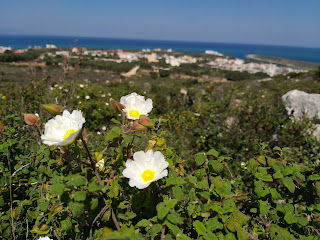
wood). Moreover, I live in a scenic area between olive groves full of
wildflowers and the sea—and I deeply appreciate that scenery and those flowers.
So my daily walks transport me beyond the stresses and horrors of the dystopian
novel too much of the world has become.
As I walk, I stop
wondering how I can find a job when so many people are unemployed and so many
businesses are closed. I don’t worry about my family in New York City and
California or the especially vulnerable homeless people and refugee families
worldwide. I don’t wonder how a just-recovering Greek economy with hospitality and
tourism at its center can survive as the lockdown continues. I don’t think
about how many tens of thousands of beloved children, women, and men may die as
a new plague sweeps the globe in a previously unimaginable neo-medieval threat.

To avoid such thoughts, I
distract myself by admiring the cottony clouds in the blue sky above, focusing
on the waves lapping against the rocks below, counting the 52 different species
of wildflowers I pass, crushing chamomile and lavender between my fingers, and
photographing and gathering blossoms. Later, when I can’t sleep, I visualize
the bright yellow of spiny broom, the white and pink of cistus on green shrubs,
the yellow and white of crown daisies, the light purple of mallow, the brilliant
fuchsia of field gladiolas. Their colors cheer and calm me.
Aside from walks, my only
other escape from home is the shopping trips that used to annoy me. On the
second of my three drives outside my neighborhood in a month, I noticed redbud
trees in bloom, blue-green sea currents meeting dark blue waters, a family of bikers,
a yard full of sheep taking care of the weeds. In some supermarkets, we must
arm ourselves with disposable gloves, plus a number to avoid overcrowding; in
others we simply wait outside if there are too many to maintain proper social
distancing. We can see people, but not approach them. Here in Crete, the store
shelves remain well stocked so far; only alcohol, wipes, hand sanitizer, and
yeast are sometimes missing. Many checkout clerks and shoppers wear gloves, and
some wear masks, although the government recommends frequent handwashing and
social distancing rather than gloves and masks. I have heard of just one
confirmed COVID-19 case in our prefecture to date.

Fines for leaving the
house without proper documentation and cause doubled to 300 euros as we
approached the Greek Orthodox Holy Week and the country’s most important
holiday, normally a two-week school vacation when city dwellers journey to
their ancestral villages and extended families gather. Government officials
have warned that Easter will be different this year, with no lambs roasted on
spits, no trips to islands, no gatherings. This is unheard of; even in wartime,
Greeks came together to eat, drink, and converse. Not this year: travel by car,
bus, boat, and plane is forbidden, except for Greeks who are returning to their
permanent home with tax forms showing that address. This is a huge blow to
Greek tradition and culture, but most understand that it is a necessary
follow-up to the early
stringent measures that have helped prevent the level of tragedy seen in Italy,
Spain, and the USA.
In relative isolation at
home with my family, I have been in touch with more distant family and
long-lost friends than ever before: friends from middle school through grad
school and relatives from Vancouver to New York. I read that Americans are
making more phone calls than usual, but here in Greece I connect with North
America using email, Messenger, Instagram, Facebook, Skype, and now Zoom. The New York Times reports that in the
debate over screen time, screens have won. That they have, although I try to
keep up the fight. What can I say to the son who says he has nothing else to
do? (At least my daughter has more online classes, for more constructive screen
time.) Exercise, play with the cats, complete the bit of homework now
assigned—then use screens in the variety of ways enabled by multiplying free
online options.
 I am grateful for the
internet connection that is more of a lifeline to the rest of the world than
ever before. Amazon has not successfully completed a delivery to us in many
months, a Greek bookstore has also failed us (although the postal service still
delivers), and our TV no longer shows us any channels, probably due to a cable
malfunction no one can fix now. It’s a good thing I have one of the largest
collections of American fiction on the island of Crete; I am starting yet
another round of rereading.
I am grateful for the
internet connection that is more of a lifeline to the rest of the world than
ever before. Amazon has not successfully completed a delivery to us in many
months, a Greek bookstore has also failed us (although the postal service still
delivers), and our TV no longer shows us any channels, probably due to a cable
malfunction no one can fix now. It’s a good thing I have one of the largest
collections of American fiction on the island of Crete; I am starting yet
another round of rereading.
The state of the developed
world in the pandemic: connected to screens, connected through screens,
nervous, restless, wondering. The human world is in disarray, with
unprecedented situations becoming the new normal. We reach out across
cyberspace to connect with those we care about. Meanwhile, the natural world
continues its seasonal course, with cold, wind, and rain alternating with calm,
warmth, and sun. The wildflowers thrive; the loquats ripen; the olive tree buds
swell and begin to reveal their delicate tiny white blossoms. Yes, it is spring,
and the earth is still fruitful.

 We hope that will continue
as the country begins to open up in the coming week. That is supposed to happen
gradually, with masks recommended and social distancing still required. In
addition to the supermarkets, bakeries, produce stores, and pharmacies that
stayed open, some other stores and hairdressers will admit limited numbers of
customers starting May 4, for the first time since March 13.
We hope that will continue
as the country begins to open up in the coming week. That is supposed to happen
gradually, with masks recommended and social distancing still required. In
addition to the supermarkets, bakeries, produce stores, and pharmacies that
stayed open, some other stores and hairdressers will admit limited numbers of
customers starting May 4, for the first time since March 13.


